



Why Inventory Data Is the Foundation of Modern Retail Success
Serving customers across complex retail spaces—whether Hardlines & Hardware Store, Sporting Goods, Specialty Retail, or Apparel—requires perfect execution behind the scenes. Today’s customer simply expects services like click-and-collect, endless aisle, same-day delivery, and ship-from-store to “just work”. Behind every flawless experience sits a single, non-negotiable prerequisite: accurate, real-time visibility of what you own, where it lives, and how fast it’s moving.
Retailers have always prized inventory, but the true differentiator now is the inventory data that describes that inventory. Without it, pricing is guesswork, fulfillment promises become apologies, and the whole organization is effectively flying blind. Mi9 Retail’s mission is to unify that inventory data across channels, surfacing it in real time, and translating it into action.
What’s at Stake When Inventory Data Falters
When data and physical inventory disconnect, it costs retailers millions in missed opportunities. These are the risks inherent in fragmented systems:
- Lost Sales & Stockouts: A shopper seeing “In Stock” online only to find an empty shelf erodes lifetime value and brand trust. This disconnect prevents teams from having the real-time availability necessary to capture sales across channels.
- Bloated Working Capital: Excess stock ties up cash that could otherwise fund innovation or expansion. Aged inventory often ends in margin-killing markdowns or liquidation.
- Inefficient Supply Chains: If systems disagree on true on-hand levels, replenishment turns reactive, stores hoard unnecessary safety stock, and transportation costs can soar.
- Misaligned Promotions: Discount events intended to clear slow sellers might accidentally drain high-margin best-sellers if inventory health wasn’t properly factored into the discount logic.
- Erosion of Executive Confidence & Brand: When metrics are unreliable, strategic decisions are delayed and opportunities are missed. The brand also suffers, as uncertainty about stock availability can damage its image.
Defining “Inventory Data” in the Digital Age
Inventory data today is far more than a nightly stock ledger. To power modern retail decisions—especially in sectors dealing with large SKUs counts and complex physical storage—it must be comprehensive, precise, and real-time. Modern inventory data must capture:
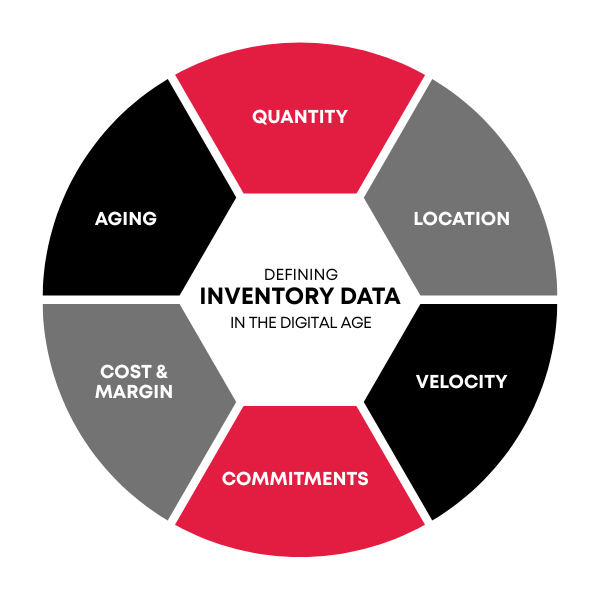
Quantity: Must be atomic: tracked for each UPC/location combination
Location: Precise down to the bin or shelf for micro-fulfillment (e.g., Rack B-5 in a DC vs. a backroom)
Velocity: Sales rate, receipts, returns, and transfers updated hourly
Aging: Days-on-hand informs the cadence of markdowns and promotions
Cost & Margin: Enables true GMROI (Gross Margin Return on Investment), not just sales volume
Commitments: Tracks reservations, BOPIS holds, and open purchase orders (POs) and inventory turns
When these dimensions feed a single real-time source of truth, retailers unlock a rich lattice of insights.
Six Strategic Benefits of Unified Inventory Data
Unified, trustworthy inventory data empowers every function—from strategic planning to the last mile—to operate with agility and precision.
- Frictionless Omnichannel Fulfillment: Services like BOPIS (Buy Online, Pick up In Store) and ship-from-store require instant certainty that the item exists and is reachable fast. Real-time visibility is the prerequisite for a flawless customer experience.
- Automated Replenishment & Allocation: With velocity and sell-through updated hourly, Distribution Centers (DCs) can replenish just-in-time, adjusting safety-stock thresholds dynamically based on lead time and velocity. This frees working capital and strengthens the supply chain.
- Dynamic, Margin-Savvy Pricing: The system enables retailers to selectively discount SKUs that are aging where they are aging, rather than applying blanket markdowns. Margin impact is calculated in real time, protecting gross profit.
- Assortment Localization: The platform can combine historical sales data, local demographics, and store capacity to create a laser-targeted SKU mix.
- Accurate Demand Forecasting: Predictive accuracy improves when machine-learning models ingest real-time stock health alongside external signals (web traffic, social sentiment, weather). This predictive accuracy can cut safety stock significantly (e.g., by 20% in one instance).]
- KPI Excellence & Executive Trust: When metrics like GMROI, Stockouts %, and Aged Inventory % pull from the same trusted source, reporting becomes action—not dispute resolution.
Breaking Data Silos with a Fluid Data Fabric
The traditional retail architecture suffers when POS counts disagree with WMS counts, or when e-commerce systems allocate stock against stale DC numbers.
Mi9’s approach creates a fluid data fabric by connecting and harmonizing operational layers:
- Data Ingestion: Real-time feeds connect POS, WMS, ERP, OMS, and even vendor EDI and IoT shelf sensors.
- Data Harmonization: The system cleans SKU IDs and location hierarchies to ensure a single version of the truth.
- Business Logic: Critical processes like replenishment, allocation, and reservations execute automatically, eliminating reliance on manual spreadsheets.
The result is that accurate inventory positions are surfaced wherever the business needs them—whether that’s a planogram tool, a store associate’s mobile app, or the CFO’s dashboard.
Control Your Inventory Data, Control Your Outcomes
Retail success in 2026 and beyond is about knowing exactly what you have and making it work harder than your competition’s. Mi9 Retail provides the technology backbone that turns data into confident decisions, shelves into profit centers, and customers into loyal advocates. Click Here To Learn more about how Mi9 Retail approaches Inventory Data & Retail Analytics.